

Start with your day, not a shopping list
An everyday safety kit should solve the problems you actually encounter. A person who walks home after dark may need accessible lighting and reflective material. Someone who travels across town for work may value a charged phone and a compact backup battery. Begin by thinking about a normal weekday: where you go, how you travel, where you could ask for help, and what you would miss if your bag were unavailable. A small, familiar collection is usually easier to maintain than a heavy assortment of unfamiliar gadgets.
Give every item a clear job
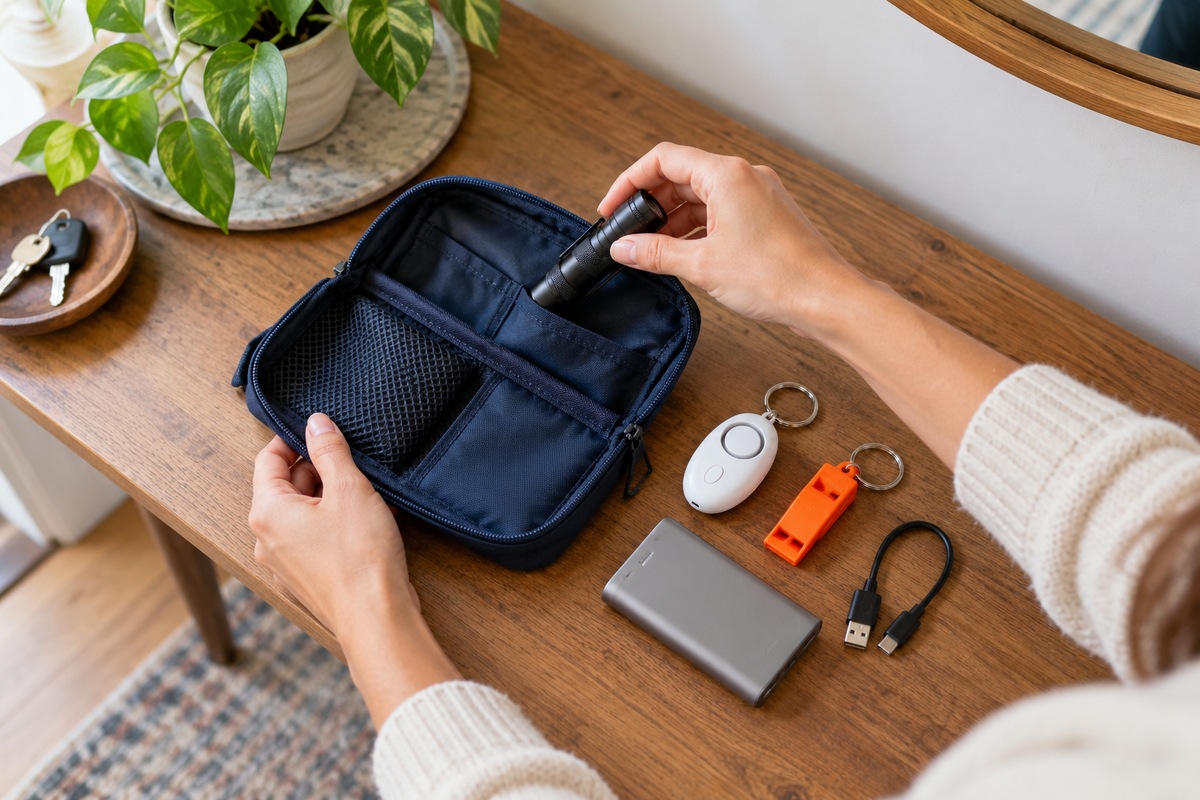
Choose a few useful functions: seeing your route, attracting attention, and keeping communication available. A compact flashlight, a personal alarm or whistle, and a compatible phone charging cable may cover those needs. These items cannot guarantee protection or replace leaving an uncomfortable situation. Avoid adding equipment solely because its packaging promises confidence. Write down what each item does, what it depends on, and what you will do if it fails. If two objects serve the same purpose, decide whether the extra weight earns its place.
Arrange the kit for access
Keep frequently used equipment where you can reach it without emptying the entire bag. A zipped inner pocket may protect a battery but make an alarm difficult to find. An external attachment may improve access while increasing snagging or accidental activation. Try the arrangement in the clothes and bag you normally use. Check that loose keys cannot damage a charging port and that a pull-pin alarm stays secure. Keep cords short and contained. Select closures that you can operate comfortably with your usual hand strength and dexterity.
Practice ordinary actions calmly
At home, rehearse finding the flashlight, turning it on, connecting the charger, and locating the alarm control. Follow the manufacturer’s instructions for any sound test, warn others, and protect hearing. You do not need surprise drills or frightening scenarios. The aim is to discover small usability problems before relying on the kit. If reaching an item is awkward when you are relaxed, revise its location. Invite household members to understand your arrangement without assuming that everyone needs the same tools or can use the same controls.
Keep a separate plan for larger emergencies
A pocket pouch is not a replacement for household emergency supplies. The federal emergency-kit checklist includes broader needs such as water, food, lighting, and radio communication. Decide which items belong on your person, which can stay at work, and which require a larger home kit. Store important contact information in a secure, usable form rather than relying entirely on one phone. Avoid displaying sensitive personal details on the outside of the pouch. Keep the everyday setup light enough that you will take it with you consistently.
Use a short review routine
Review the kit after using an item, changing bags, or starting a different commute. Inspect batteries, cables, attachments, and closures according to their instructions. Remove damaged equipment rather than keeping it as an unreliable backup. Set a recurring reminder to check readiness, and adjust that schedule to actual use and manufacturer guidance. A useful final question is simple: can I find, operate, and explain every item here? Familiarity, accessible placement, and a realistic plan make the collection more useful than adding another gadget.
Further reading: Ready.gov emergency supply checklist.