
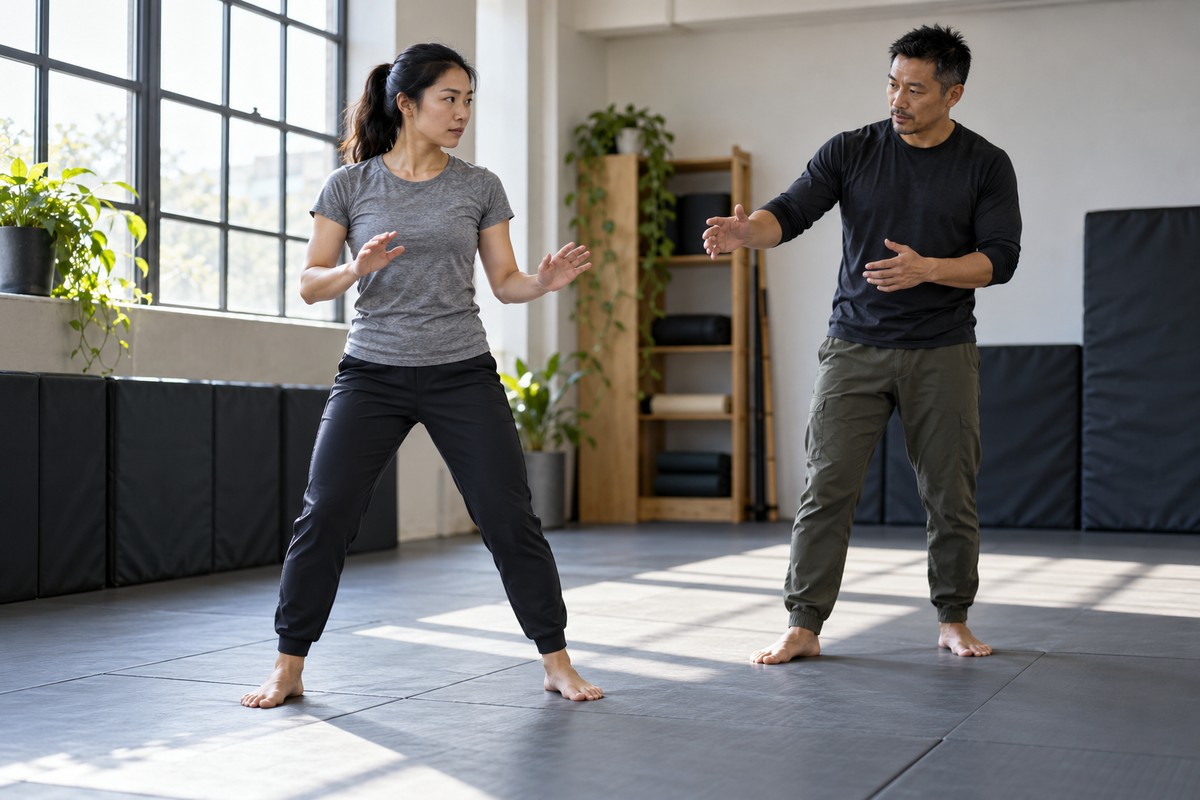

Start with a position you can maintain
A useful training position should allow you to move without straining to hold a dramatic pose. Beginners sometimes imitate very wide stances or rigid postures because they look powerful. If the position makes turning, stepping, or communicating difficult, its appearance is not a useful measure of its value.
Ask your instructor to help you find a comfortable starting position suited to your body. Footwear, mobility aids, joint limitations, and the practice surface all affect what is appropriate. There is no single stance that every participant must reproduce exactly.
Control matters more than speed
Slow movement allows you and your coach to notice whether you remain balanced, have enough space, and can stop when asked. Rushing can hide mistakes or encourage a training partner to compensate for you. Begin with predictable movements and an agreed stopping point.
A simple exercise is to move a short distance toward an open area, stop comfortably, and check whether you can look around and speak without needing to regain your footing. Keep the surface clear. Do not add pushing, pulling, or surprise resistance to an unsupervised exercise.
Consider the space around you
Movement is only useful if the destination is available. In real environments there may be chairs, bags, curbs, other people, or limited turning space. Training should eventually help you notice those conditions rather than focus only on an imagined opponent.
A classroom can introduce this idea using harmless floor markers or widely spaced chairs under supervision. The objective is to identify a clear path and move deliberately, not to weave quickly through obstacles. Do not practice beside stairs, traffic, sharp furniture, or slippery surfaces.
Adapt the lesson to your abilities
Balance does not always mean standing. Seated participants and wheelchair users may work on comfortable positioning, managing available space, communication, and access to an exit. An instructor should ask what movements are suitable rather than assume that everyone can change direction or stand up in the same way.
Fatigue also changes participation. An exercise that felt manageable at the start of class may need adjustment later. Pausing or asking for a variation provides useful information about how the training fits you; it is not a failure of determination.
Make movement part of a decision
Once a basic movement feels familiar, connect it to a practical question: where would you go next, and why? A step that creates more room may be useful if it also preserves an exit. Moving without considering the destination can reduce your options.
At the end of a lesson, record the coaching cue that helped most. Perhaps you remembered to slow down, look toward the available route, or stop before becoming tangled with a partner. Practice only the low-risk movement your instructor has approved.
Balance and controlled movement are foundations for learning. They do not guarantee an outcome in a confrontation, but they can make supervised practice clearer, more adaptable, and easier to evaluate.
A practical reflection exercise
Ask your coach to watch a short movement toward an agreed open space. Before starting, explain where you intend to stop. Afterward, check whether you stayed comfortable and whether anything interrupted the movement. Repeat only after receiving feedback. If the exercise is seated, use the positioning and movement that suit your equipment and access needs. The useful comparison is between your own clearly understood attempts, not between your movement and someone else's speed. Stop if the space or task does not feel manageable.