
Begin with a useful definition
Self-defense is a set of choices intended to protect your ability to get away from harm. Physical skills can be part of that process, but a beginner also needs communication, judgment, and an understanding of the environment. A course that teaches only combinations of movements leaves out decisions that may matter before contact ever occurs.
You do not have to become fearless before beginning. It is reasonable to arrive with questions, mixed feelings, or no athletic background. A useful first goal is to understand what the class teaches and how you can participate at an appropriate pace.
Protect your ability to choose
Think about the options available in an ordinary interaction. Can you end the conversation? Is there a clear route to a staffed place? Could you ask a specific person for assistance? Looking for choices gives awareness a practical purpose.
This does not mean you must wait for certainty before changing plans. You can move away from an uncomfortable situation without accusing anyone of wrongdoing. Decisions should be based on behavior and circumstances rather than assumptions about a person's appearance, background, or identity.
Learn communication alongside movement
Simple phrases can be easier to use than a long explanation. In a class, practice saying “Please step back,” “I do not want to continue,” or “I am leaving.” Your instructor should also discuss situations where speaking directly might increase risk and where quietly disengaging is more appropriate.
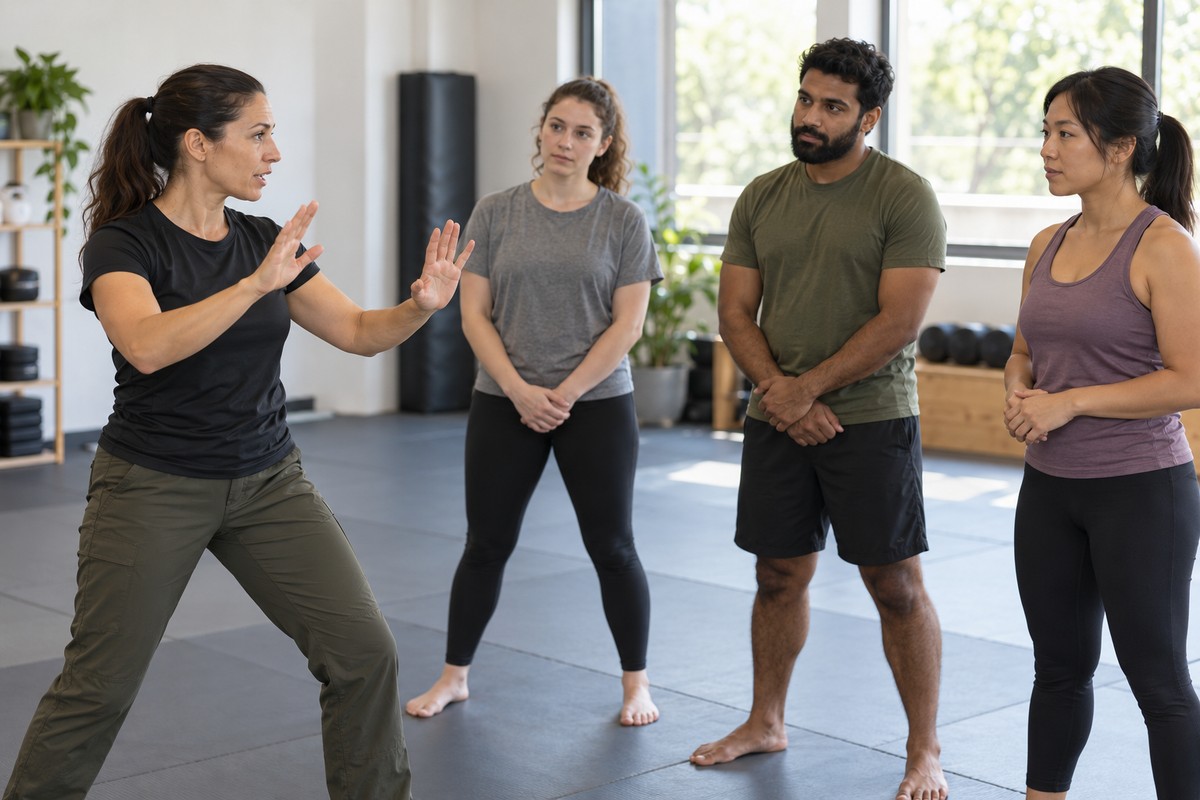
Movement practice should emphasize balance, available space, and stopping under control. Start slowly, without surprise contact. A written description cannot confirm whether your position suits your body or whether an exercise is being performed safely; ask for direct coaching rather than copying a dramatic video.
Know the limits of a lesson
A successful classroom repetition is evidence that you completed that exercise under those conditions. It is not proof that a technique will work against every person or in every environment. Size differences, restricted movement, fatigue, and unexpected behavior can change what is possible.
An instructor should welcome questions about limitations. Promises of guaranteed protection, instant mastery, or a single answer to every attack deserve skepticism. Responsible teaching makes room for adaptation and acknowledges that no one can control another person's actions.
Try a low-pressure starting exercise
Before your first session, write down one learning goal and one boundary. Your goal might be to become more comfortable speaking firmly. Your boundary might be no physical contact until you have watched the exercise and agreed to participate.
After class, note one concept you understood, one question you still have, and one change that would make the next lesson more useful. Share relevant access needs with the instructor privately if you wish. Progress can mean clearer decisions and better communication as well as improved movement.
Responsibility for violence belongs to the person committing it. Self-defense education should expand your choices without suggesting that being harmed reflects a failure to train or respond correctly.
A practical reflection exercise
Imagine arriving at an unfamiliar community event. Before thinking about a physical technique, identify who is working there, where you can leave, and how you would contact your companion. If an interaction becomes uncomfortable, choose one response that preserves those options. Discuss the choice with your instructor rather than searching for the most dramatic response. This example can help you connect the first lesson to everyday decisions. You are practicing a way to think, not trying to anticipate every possible incident or judge other visitors as threats.